Recently searched

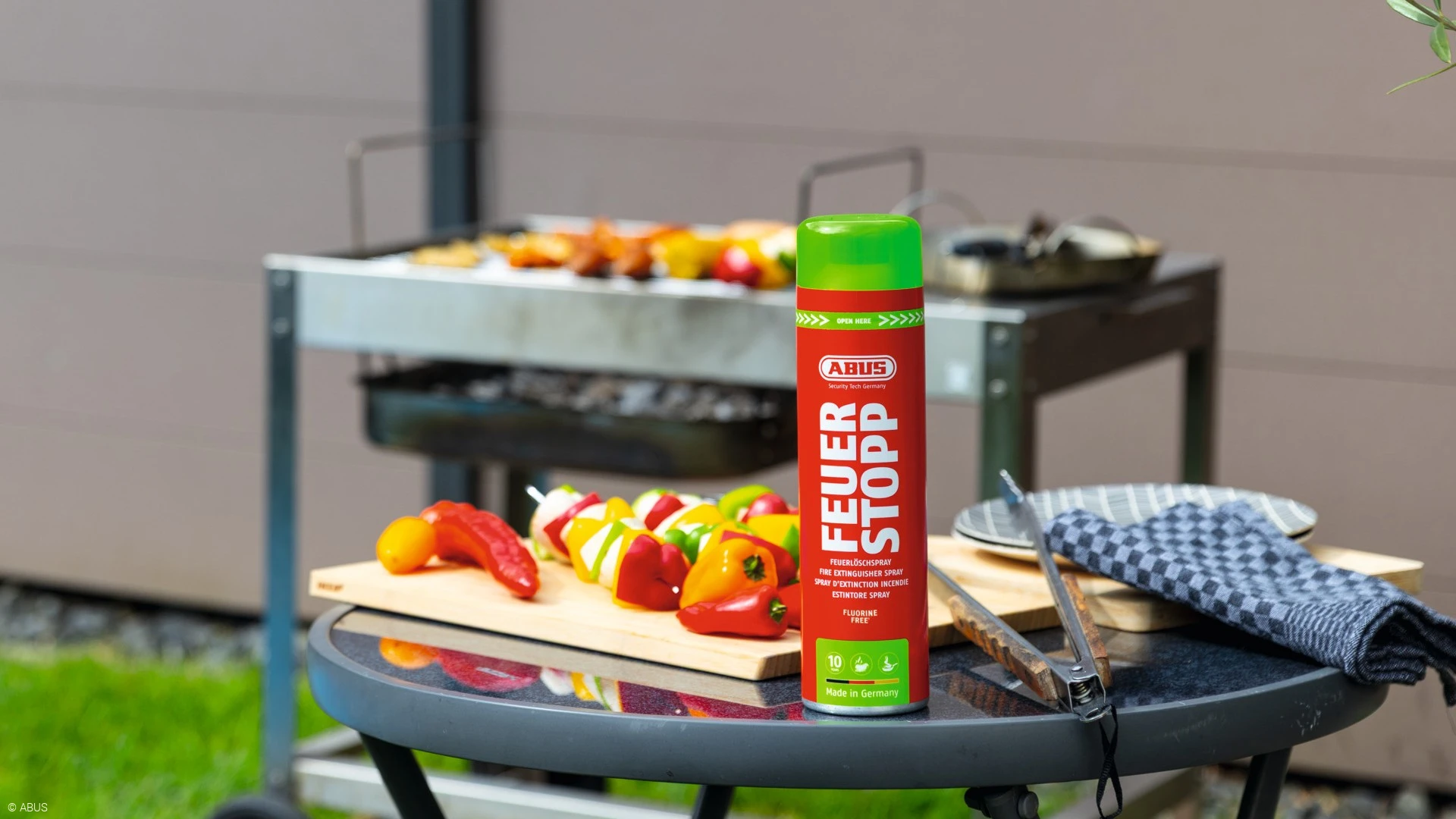
    Im Notfall schnell reagieren, mit dem FeuerStopp © ABUS

    Fire protection guide To extinguish correctly

    To be able to act in an emergency, you should know the answers to the following questions: How does a fire start in the first place? How do I extinguish it correctly? Why do I have to pay attention to fire classes when extinguishing?

    In this part of our ABUS fire protection guide, you will find rules, tips and information on the following topics:

    The most common causes of fire:
    Human misbehaviour- Icon
    Menschliches Fehlverhalten
    Electrical fire - Icon
    Elektrobrand
    Open fire - Icon
    Offenes Feuer

    It's on fire - and now?

    Keep calm and assess fire
    First of all, do not panic! Assess the type and extent of the fire. You can sometimes extinguish smaller fires or incipient fires yourself through the targeted use of extinguishing agents. However, only try to do this if you do not endanger yourself or others. It is better to call the fire brigade once too often and, if in doubt, leave the building as quickly as possible - because a fire is always unpredictable.

    The 5Ws: What to say during an emergency call
    You are unsure whether a fire still counts as an incipient fire? You feel the heat is so great that you can no longer enter the room? Leave the house and alert the fire brigade on 112. The five "Ws" will help you in this extraordinary situation:

    • Who is calling? Name 
    • Where is the event? City, district, street, house number 
    • What happened? Fire, accident (or similar)
    • How many people are affected? Are any persons injured or missing? 
    • Waiting for queries! Do not hang up immediately

    4.Step ©ABUS

    • With the wind: Attack the fire downwind
    • From the point of origin to the puddle: Extinguish dripping and flowing fires from top to bottom
    • For wall fires: Always extinguish from bottom to top
    • Extinguish in a targeted manner: Aim at the embers, not at the flames
    • For larger incipient fires: Use several fire extinguishers at the same time, do not use them one after the other: Observe the fire site and extinguish again if necessary
    • Ensure replenishment: Replace the fire extinguisher after use

    Source: Brandschutz Zentrale 

    ABUS fire protection products:

    To extinguish grease fires and electrical fires

    Grease in the pan that ignites itself or the multiple socket that ignites a smouldering fire: In the domestic environment, grease fires and electrical fires are frequent fire scenarios.

    REMOVE THE BASIS OF THE FIRE 
    A fire needs three factors: Fuel, heat and oxygen.
    All fire-fighting methods are based on depriving the fire of one or more of these fundamentals - for example by smothering (fire blanket, foam extinguishing agent), cooling (water) or a firebreak (for forest fires).

    You must never extinguish a grease fire with water, as there is a risk of dangerous grease explosions. CO2 fire extinguishers and powders are also unsuitable, as they can produce a jet of flame. Instead, extinguish with a class F grease fire extinguisher - up to 15 litres, for example, with our ABUS fire extinguishing spray. This is the right way to proceed if grease ignites:

    1. Turn off the cooker
    2. Remove the pot/pan from the cooker
    3. If possible: Put a metal lid on to deprive the fire of oxygen
    4. Use a class F grease fire extinguisher. 

    Fire class E is no longer listed today, as electricity is not flammable in itself. In the event of an electrical fire, the following applies: Never extinguish with water! Because electricity is involved, there is a risk of electric shock. Instead, proceed as follows:

    1. Cut off the power supply: Tilt the main fuse or pull out the plug
    2. If the power no longer flows: Use a fire extinguisher of fire class A - for example ABUS fire extinguishing spray
    3. If you cannot interrupt the power supply: Use fire extinguisher, for example fire class C powder extinguisher 

    Class A solids often ignite in residential fires. These include, for example, paper, textiles, plastic or wood. Since embers form, you need an extinguishing agent to contain the flames and extinguish the embers. Water is suitable here: it cools and reduces the oxygen supply. Quicker to hand and also suitable are our ABUS foam extinguishing agents. „Fire stop“ and our Fire blanket.

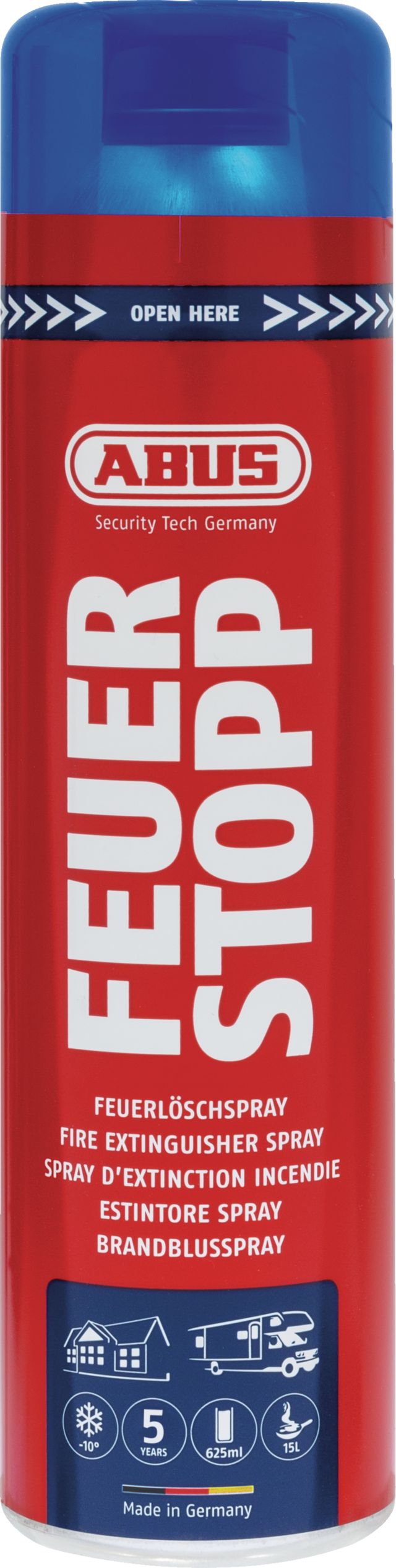
    Feuerstopp AFS625

    Fire extinguishing spray Fire Stop AFS625

    Experience

    EXTINGUISHING ACCORDING TO FIRE CLASSES

    Fires are classified according to their fuel. The flammable substances are divided into fire classes A, B, C, D and F.

    Each of these fire classes comprises a specific group of flammable substances, which in turn provides information on which extinguishing agent is suitable. The fire class is marked on extinguishing agents such as a fire extinguisher.

    Fire class overview with suitable extinguishing agents:

    Brandklasse A © ABUS
    Fire classification A

    Incendiary material: Solid, non-melting substances
    Examples: Wood, paper, textiles, coal, non-melting substances
    Appearance: Embers and flames 
    Suitable ABUS products: Fire extinguishing spray

    Brandklasse B  © ABUS
    Fire classification B

    Incendiary material: Liquids, melting substances
    Examples: Solvents, oils, waxes, melting plastics 
    Appearance: Flames 
    Suitable ABUS products: Fire extinguishing spray

    Brandklasse C  © ABUS
    Fire classification C 

    Incendiary material: Gases
    Examples: Propane, butane, acetylene, natural gas, methane, hydrogen
    Appearance: Flames
    Passende Löschmittel: ABC Powder, BC Powder. Attention: Only extinguish when the gas tap is turned off or excluded!


    Brandklasse D  © ABUS
    Fire classification D

    Incendiary material: Metals
    Examples: Natrium, Magnesium, Aluminium
    Appearance: Glut
    Suitable extinguishing agents: Metal burning powder, dry sand, cement 

    Brandklasse F  © ABUS
    Fire classification F 

    Incendiary material: Edible fats and oils in deep fat fryers or fat baking devices 
    Examples: Edible fat, edible oils 
    Appearance: Flames
    Suitable ABUS products: Fire extinguishing spray

    Loading ...