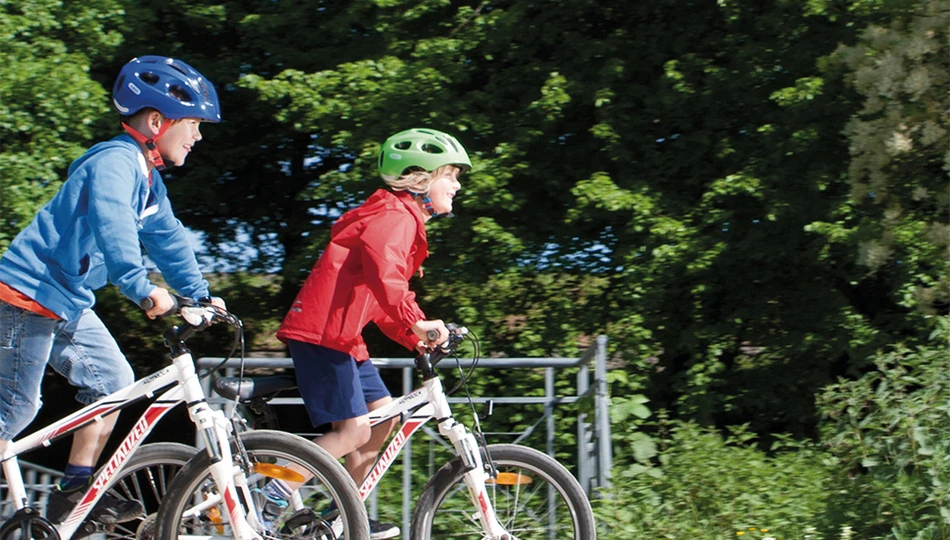
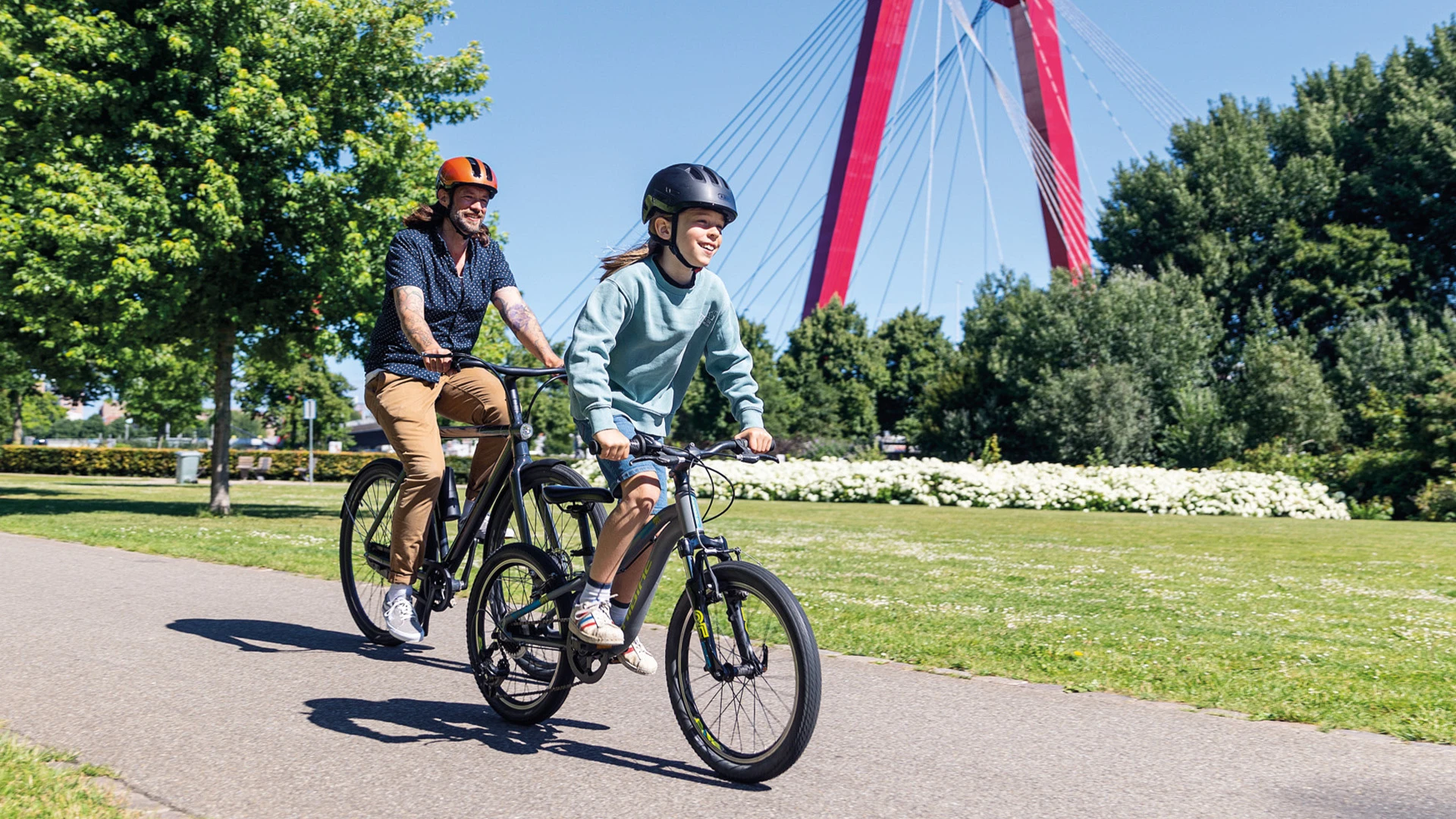
Adult and child wearing ABUS bicycle helmets riding on a bike path in the park in sunny weather; red suspension bridge in the background © ABUS

BICYCLE HELMETS Why they are important

Statistics show that helmets significantly help to prevent serious head injuries.

Although many people avoid wearing helmets for reasons of comfort, a helmet could save your life in an emergency. In this guide, you will learn how modern helmets combine safety with comfort and what measures you can take to further increase your safety on the bike.

According to surveys, almost half of all cyclists still never wear a bicycle helmet. Only 20 percent of cyclists always wear a helmet, even though the head is often the most vulnerable part of the body in a bicycle accident. Studies show that around 85 percent of bicycle accidents result in head injuries, which often cause permanent damage.

However, around 80 percent of these injuries could be avoided by wearing a bicycle helmet. Find out here why a bicycle helmet is so important in the event of an accident and how you can best protect yourself when cycling.

Teaser_Grafik_Fahrradhelm

Bicycle safety and helmets: what the figures say

The Federal Statistical Office reported that around 85,000 bicycle accidents were recorded in Germany in 2021. Of these, 68,000 accidents involved conventional bicycles and 17,000 involved pedelecs or e-bikes. The increasing popularity of electric bikes is also reflected in the accident figures. While the number of accidents involving conventional bicycles fell by 12 percent between 2014 and 2021, the number of accidents involving e-bikes rose significantly, from 2,223 in 2014 to 17,045 in 2021, an almost eightfold increase.

Whether due to contributory negligence or not, insurance experts are seeing not only an increase in bicycle and e-bike accidents, but also an increase in the severity of the resulting injuries. Cyclists are often affected primarily in the shoulders, arms, and legs. According to data from the German Society for Trauma Surgery from 2016, injuries to these areas of the body are particularly common in bicycle accidents, accounting for 60 percent of all injuries. The types of injuries range from superficial damage such as minor abrasions, bruises, and contusions to more serious injuries such as fractures of the wrists, forearms, and legs, as well as pelvic fractures, especially in older people.

The reasons for this are simple: when a person falls, they reflexively break their fall with their limbs, which often leads to injuries to the aforementioned parts of the body. There is little protection possible here, and although fractures do occur, they are rarely life-threatening. In serious or fatal accidents, however, head injuries are the most common and most serious injuries. This is precisely the argument repeatedly put forward by proponents of compulsory helmet use, because although helmets do not prevent accidents, they do prevent serious injuries.

Cyclists more vulnerable than pedestrians, children less vulnerable than older people

Zwei Kinder radeln im Park und tragen ABUS Youn-I MIPS Kinderhelme © ABUS

The risk of suffering a serious head injury in a collision with a car is much higher for cyclists than for pedestrians. Cyclists often travel at higher speeds, which increases the risk of serious injury in accidents. Interestingly, however, the risk of children on bicycles suffering serious head injuries in a car accident is lower than for adults. The reason for this is probably that children usually collide with the softer hood of a car in an accident rather than the windshield, which can reduce the severity of injuries. Nevertheless, it is important that children always wear a suitable helmet when cycling to minimize the risk factors.

Tip: Whether you're looking for a brightly designed helmet for toddlers, a stylish bike helmet for teenagers, or a special NTA helmet for S-pedelecs and similar bikes, you'll find the right helmet model for every age and every need in the ABUS range.

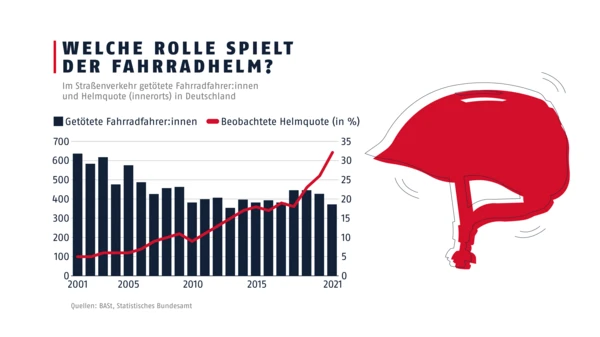
The German Traffic Safety Association confirms the protective function of bicycle helmets through scientific research, and the ADAC also recommends always wearing a helmet when cycling. However, a helmet is not the only factor that influences the overall safety of helmet wearers and cyclists. Accident statistics from Statista show only a correlation, not a direct causal relationship. Nevertheless, the trend is clear: over the last two decades, the use of helmets among cyclists has increased, while at the same time the number of cyclists killed in traffic accidents has fallen dramatically.

The German Traffic Safety Association points out that a significant percentage of cyclists involved in accidents suffer head injuries – according to this, helmets may have made a positive contribution to increasing safety in road and bicycle traffic.

Diagramm zu tödlichen Fahrradunfällen im Straßenverkehr und Helmquote in Deutschland

The mandatory wearing of helmets is therefore a recurring topic of discussion, but is currently unlikely to be implemented.

Helmet wearing rate at a glance

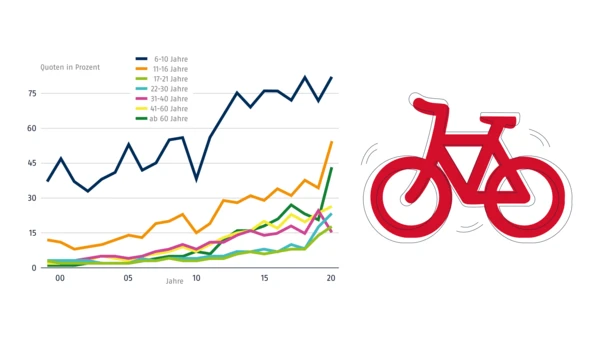
Statistics and tests repeatedly show that in the event of a bicycle accident, a helmet reliably protects the head, which is the most sensitive part of the body. Despite the proven protective effect of helmets, the helmet wearing rate in 2022 was only 40.3 percent. At 34 percent, the rate among conventional cyclists was much lower than among pedelec riders (60.1 percent). On a positive note, however, children between the ages of six and ten were the most likely to wear a helmet (81.3 percent), and children between the ages of eleven and sixteen as well as older people have also been wearing head protection more and more frequently in recent years.

Why do so many people not wear a bicycle helmet

In surveys, most people cite comfort as the main reason for not wearing a helmet. For many, helmets are simply uncomfortable to wear. Other reasons include excessive sweating, the effect on hairstyles, and similar factors. However, modern helmets are in no way comparable to older models: bicycle helmets available on the market today are generally extremely lightweight and usually very well ventilated, ensuring a high level of comfort. In addition, flexible adjustment systems allow them to be individually adapted to the shape of the head, making them more comfortable to wear and offering improved protection.

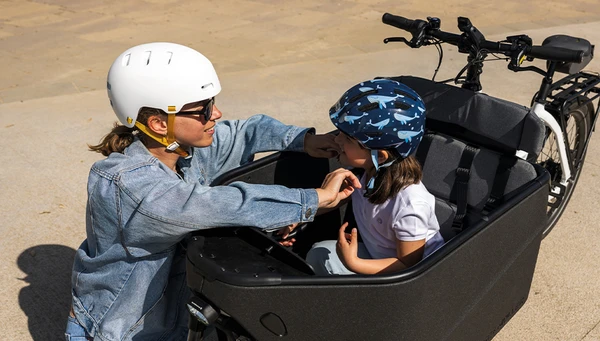
Woman wearing the urban bicycle helmet XOXO while adjusting the Smiley 3.0 blue whale children's helmet for her child in a cargo bike. © ABUS

Man on a bicycle looks back and wears the HYP-E urban bicycle helmet in midnight blue. © ABUS

There are numerous advantages to wearing a bicycle helmet:

  • A helmet can help prevent serious head injuries.
  • The inner hard foam material of bicycle helmets, for example, absorbs the linear impact forces exerted during a fall.
  • The MIPS (Multi-Directional Impact Protection System) in bicycle helmets is also designed to reduce rotational forces during an impact, thereby improving protection against brain injuries.
  • Equipped with rear lights or reflective strips, a helmet can increase the visibility of cyclists in traffic.
  • Adults who wear helmets serve as positive role models for children.

Unfortunately, unlike cars, humans do not have a crumple zone, and complete bicycle safety is not possible in road traffic.

In a bicycle accident, the human body always hits a hard surface, whether it is the road or other vehicles. Apart from bicycle helmets, there are hardly any widespread safety standards or suitable safety equipment for cyclists in road and bicycle traffic. Bicycle accidents can only be avoided by increased caution on the part of all road users. Wearing a bicycle helmet does not prevent accidents, but it significantly reduces the risk of serious head injuries. In addition, you should follow these four tips:

  • Crossing hazards: Cyclists have no crumple zone and are often difficult for motorized road users to see, especially at intersections. There is a risk that cyclists will be overlooked by truck drivers turning, particularly due to blind spots. An important rule for cyclists is therefore to keep a safe distance from large vehicles.
  • Maintain safe distances: Cyclists should keep a sufficient distance from the right-hand edge of the road, ideally one meter from the sidewalk and one and a half meters from parked cars, to avoid collisions with suddenly opened doors (dooring). This distance creates a safety zone and prevents cars from overtaking too closely. Even if drivers seem impatient: in many cases, it is correct that they cannot overtake if the distances are maintained correctly.
  • Use bike lanes: Whenever possible, you should ride on a bike lane for your own safety. If it is marked with an appropriate traffic sign, you are even required to use it. However, if the bike lane is blocked, in poor condition, or heavily littered, you may also use the road.
  • Adapt your riding behavior: Cyclists should always observe the basic rules of the road, such as right of way rules and clearly signaling turning maneuvers. They should also always expect other road users to make mistakes, especially when turning right, as they sometimes fail to give way to cyclists. Increased speed is also one of the risk factors for accidents: thanks to e-bikes, cyclists are now traveling much faster than in the past, which many motorists still underestimate and therefore cause accidents. On the other hand, those who drive empathetically, attentively, and with foresight can greatly increase their own safety and that of others on the road.

Loading ...